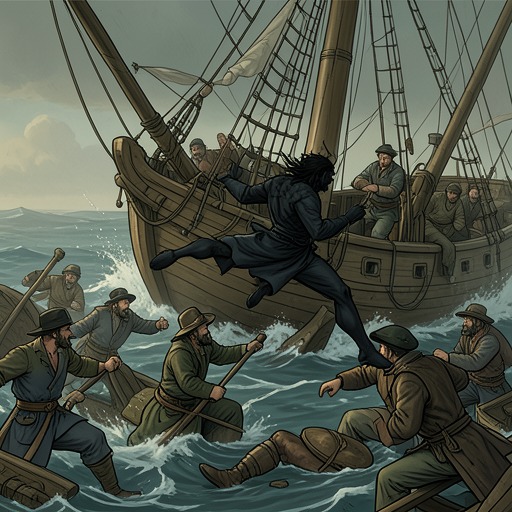
Umbraught extermination policy
Chasing SunlightThe Umbraught extermination policy is the Inquisition doctrine that Umbraught should be destroyed on sight rather than studied, avoided, or tolerated. Antomine presents it as a necessary defense of human civilization: because Umbraught consume luminiferous terrestrite, they threaten the zint-based infrastructure on which the human world depends. The policy therefore joins religious judgment to energy security, treating an entire nonhuman population as an enemy whose continued existence is itself dangerous.
Origins in the Light-Bound Order
The policy belongs to a world organized around scarcity, darkness, and the political authority of the Illuminated King. Humanity survives beneath lightless skies as a vigil against eternal darkness, while the crown and the Reflected Council regulate the boundary between protected human lands and the territories beyond them. At Danby’s Point, the easternmost terminus of human civilization, this boundary is materialized by a great metal gate and intense zint illumination. Trade crosses the frontier, but the contact is deliberately contained, and the darker peoples encountered beyond the gate are described through the language of savagery, distortion, and threat.
The policy’s historical justification is tied specifically to the Illuminated King. When Antomine recognizes the painful dark light in Angkor Leng, he explains that the Umbraught consume luminiferous terrestrite and that the Illuminated King destroyed or drove them out hundreds of years earlier. The earlier campaign is thus remembered not as a disputed conquest but as a completed act of protection. The policy inherits that precedent: extermination is framed as the restoration of an established order rather than as a new decision requiring proof.
Antomine’s Rule of Action
Antomine states the doctrine in its starkest form when he says that Umbraught are best exterminated on sight. His language leaves no room for negotiation, observation, or distinctions among individual creatures. The rule is categorical because the threat is understood collectively: wherever a nest exists, the possibility of continued consumption of zint and luminiferous terrestrite is enough to justify its destruction.
The immediate circumstances in Angkor Leng reveal how the policy operates. The Endeavor’s unusually powerful zint illumination may have attracted the Umbraught, and Antomine suspects that his own presence is at least as likely an explanation as the ship’s lights. Even while the airship is damaged and its crew is trying to preserve the expedition’s route eastward, Antomine insists that any nest in the city must be purged. Once the Umbraught know that zint exists, he argues, they will hunt it down; if they travel west, the consequences for human settlements cannot be predicted.
This logic converts a possibility into an emergency. The Umbraught have not yet been shown attacking the human lands in the exchange, but their capacity to follow the energy source is treated as sufficient evidence of future danger. The policy consequently authorizes preemptive violence and makes delay itself culpable. Antomine’s position is not merely that the creatures are dangerous in combat; it is that permitting them to remain alive risks allowing the darkness to move along the energy network that sustains civilization.
Conflict with Jonathan Heights
Jonathan Heights resists the policy because it conflicts with the expedition’s purpose and practical limits. He reminds Antomine that the Endeavor is not a navy and that its crew lacks the time and resources to survey and cleanse a city the size of Angkor Leng. Jonathan’s objection is not a defense of Umbraught coexistence. It is a refusal to let the Inquisition redirect the expedition toward a campaign that would delay the search for sunlight and endanger the ship’s passage to the true east.
Jonathan’s priorities have already shaped the expedition’s material organization. At Campbell Yards, he offers four luminiferous gems to improve the Endeavor’s engines, and at Danby’s Point he loads a portable luminiferous terrestrite distillation apparatus, a lifting-gas separator, water equipment, searchlights, zint guns, food, spare parts, and other supplies. The ship’s movement, defense, and survival all depend on energy-intensive infrastructure. Yet Jonathan treats that dependence as a means to reach sunlight, whereas Antomine treats it as a collective inheritance that must be defended even when doing so obstructs the journey.
Antomine answers that civilization is built by doing more than the bare minimum and that present actions determine what will be possible for those who follow. His argument expands the policy beyond immediate military necessity. Extermination becomes a duty owed to future human travelers and settlements. Jonathan, by contrast, sees the demand as an imperial distraction: the eastern frontier already requires navigation, trade, mapping, repair, and negotiation, and the expedition cannot assume responsibility for every danger encountered there.
Energy, Weapons, and the Threat to the Endeavor
The policy becomes more persuasive to Jonathan when Antomine identifies the Umbraught’s direct vulnerability. The ship carries fire dust and unflame, along with relics stored in Jonathan’s cabin, but its most important exposed resource is the zint in its engines. Antomine warns that the Umbraught might drain that energy and render the Endeavor unable to move. This possibility changes the dispute from an abstract question of Inquisition policy into a concrete threat to the expedition’s survival.
Antomine nonetheless admits that he lacks the tools to address the damaged situation in Angkor Leng and would need raw terrestrite. Jonathan answers that refueling is planned after the Caldera and asks whether the problem can wait. Antomine agrees that trying to preserve the ship is worthwhile, but he does not abandon the larger demand for extermination. The policy therefore operates on two levels: immediate protection of the Endeavor’s engines and a broader insistence that the Umbraught population be eliminated before it can spread toward the west.
The doctrine also exposes a contradiction within the human energy regime. Human industry extracts and distills luminiferous terrestrite in enormous glass-and-steel stacks, and the Endeavor carries equipment designed to process or replenish the same resource in the wilderness. Human civilization depends on taking, refining, transporting, and weaponizing sources of light. Umbraught dependence on that resource is instead treated as parasitic and intolerable. The policy makes the distinction politically rather than ecologically: human extraction is civilization’s infrastructure, while Umbraught consumption is invasion.
Consequences and Significance
Jonathan ultimately acknowledges that Antomine has identified a danger he had failed to consider, even though he still has no desire to undertake a full search of Angkor Leng. He begins sorting through his notebooks and supplies for a solution, while recognizing that most of his equipment is intended to protect or conceal rather than destroy. Fire dust would not safely solve the problem, because using it across the city could expose the Endeavor to other enemy forces. The policy thus produces a strategic dilemma rather than a simple order: refusal risks the ship’s energy supply, while compliance may create a larger and less controllable battle.
Its larger significance lies in the way it defines civilization through exclusion. Human settlements extend their illuminated infrastructure eastward, negotiate at frontier markets, map the Verdant Expanse, and load technology for further expansion. At the same time, the Inquisition preserves that expansion by classifying incompatible beings as exterminable. The Umbraught policy is therefore both defensive and imperial: it claims to protect human life, but it also protects the monopoly through which human powers decide what kinds of beings may inhabit the energy frontier.
The policy stands in sharp contrast to Jonathan’s eventual arrival in Bright Defile. There, beyond the narrow valley, sunlight reveals a green country whose leaves, stones, waters, and sky contain the secrets of all time and space. Jonathan’s movement toward that open revelation is marked by repeated losses and by the rejection of institutional and supernatural authorities, including the Players and the Game. Against that final expansiveness, the Umbraught extermination policy represents the older order’s fear of uncontrolled knowledge, uncontrolled movement, and uncontrolled access to light: it answers uncertainty by destroying the beings associated with it.